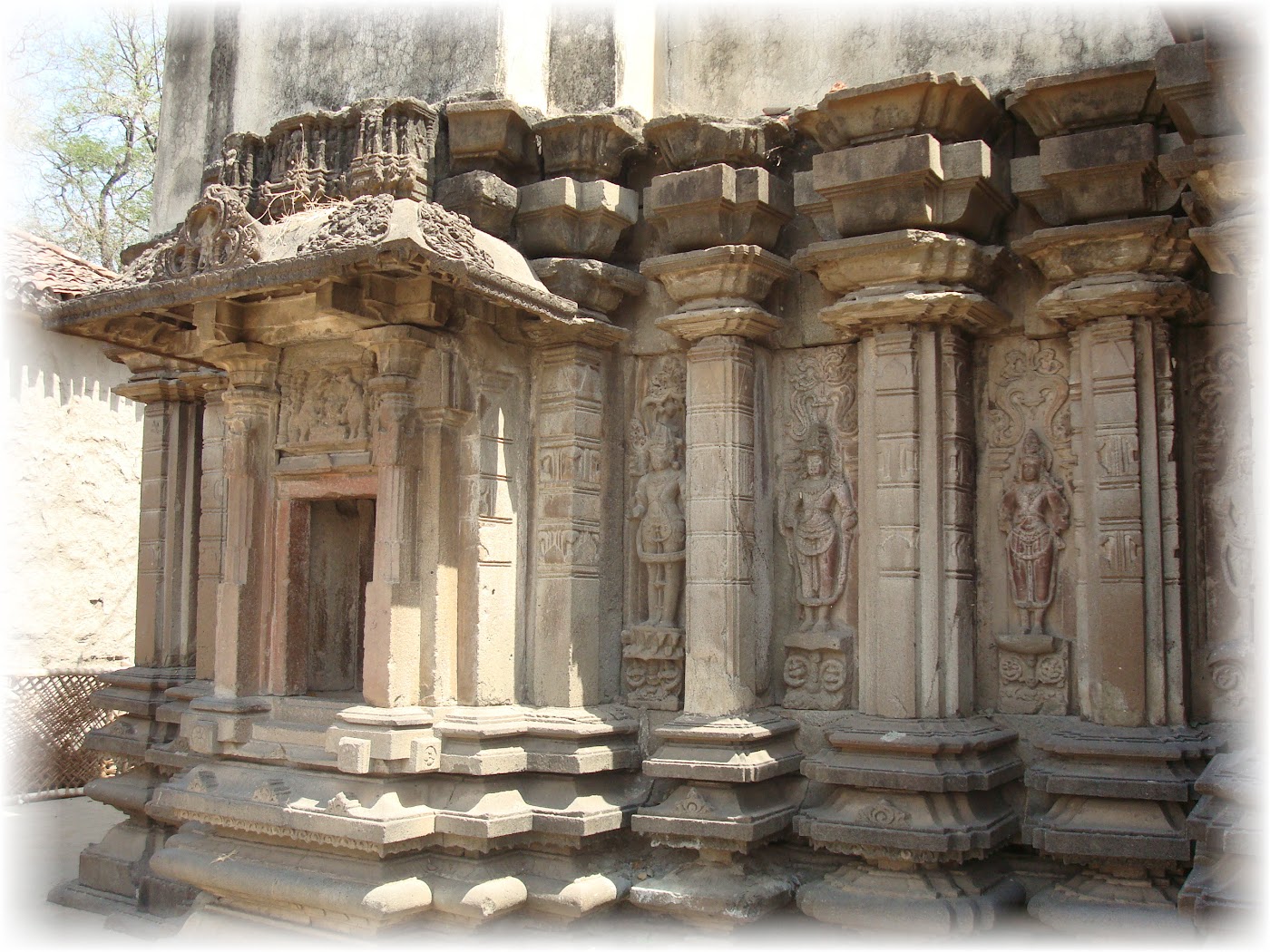
Mukhed's oldest standing landmark predates the town's own modern name — a working Chalukya-era shrine that has stood at the centre of the town for close to a thousand years.
Built by the Kalyani Chalukyas
Mahadev Mandir was raised during the reign of Vikramaditya of the Kalyani Chalukyas, placing its origins around the 12th century. Carved in the temple-building idiom of that era, its stone predates Mukhed's own modern name — the town was still known as Mohanavati Nagar when this shrine was built, and has grown up around it ever since.
The Ramayana legend behind the name
This place also carries an older story. Local tradition holds that King Dashratha — father of Lord Rama — accidentally killed the devoted Shravan Bal near a lake here while hunting, mistaking the sound of him drawing water for an animal. Shravan's grieving parents cursed Dashratha to one day die in the same sorrow of separation from a son — a curse that, in the Ramayana, comes to pass years later. The lake is still known locally as Shrawan Chalma, and this legend has been tied to the area for centuries — though the temple itself is known today as Mahadev Mandir.
Read the fuller story
This is the short version. For the complete history of Mukhed, Mohanavati Nagar and the Ramayana legend, see the history & heritage page.
Carvings worth a closer look
Look past the main sanctum and the temple's stonework has a few details genuinely uncommon for temples of its era. The exterior walls carry Sursundari figures — celestial maidens carved in stone — alongside an unusually rare depiction of the Saptamatrikas, the seven mother goddesses, shown here as dancing figures complete with crowns and ornaments, a treatment most temples of this era don't attempt. One panel shows Alakshmi (Jyeshtha), goddess of misfortune, with four arms — one hand holding a broom — and her traditional donkey mount, another uncommon inclusion. The temple's layout follows a classic sequence: a mukha-mandapa (entrance porch) leading through two ardha-mandapas (intermediate halls) to the main Mandap, an antaral (vestibule), and finally the Garbhagriha (sanctum) holding the Shiva lingam.
Not untouched by time
A past restoration used cement rather than matching stone — the original spire was replaced with a cement replica, and the sanctum floor now carries glossy blue tiles, both a departure from the temple's original material. The adjacent Sasu Sun Vihir (stepwell) pictured elsewhere on this site sits right by the temple compound. Source: architectural detail via Durgbharari.
An active temple, worshipped by thousands every day
Mahadev Mandir remains, as it has for centuries, an active temple worshipped by thousands every day. It's the first stop if you're seeing Mukhed's temples; see the visiting guide for how to fit it into a day trip.